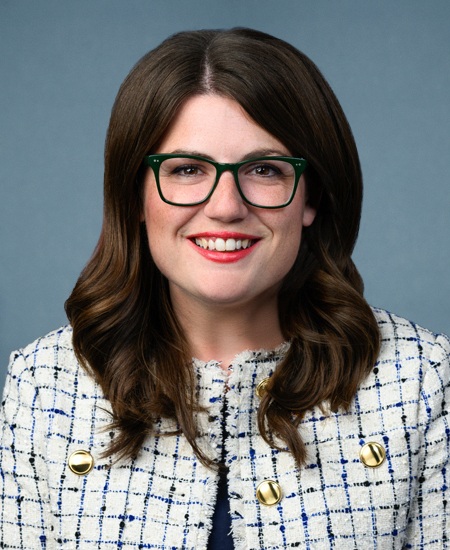
Sarah Elfreth, MD
“This bill is a good idea. I support it. This house should get this recognition. It meets all the rules for it. The Senate is playing games. They passed their own bill. They should have passed ours. I want this bill to pass.”
“I want the House to pass this bill. It connects General George C. Marshall's historic home in Virginia to the National Park Service so the site can get federal support and recognition.”
“Mr. Speaker, I yield myself such time as I may consume. Mr. Speaker, S. 603 would establish the General George C. Marshall House, the home of one of America's most influential historical figures, as an affiliated area of the National Park System. This would provide a deserved national recognition and allow the George Marshall House to receive technical assistance and limited financial aid from the National Park Service. General Marshall lived at the residence in Leesburg, Virginia, between 1941 and 1959, critical years during his career. He held an impressive resume, serving as Chief of Staff of the Army, special envoy to China, Secretary of State, Secretary of Defense, and president of the American Red Cross. He was renowned for organizing the Allied victory in World War II and for his dedication to rebuilding European economies and democracies through the Marshall Plan, which earned him the Nobel Peace Prize. His home was designated a historical landmark in 1996 for the National Park Service, and then, after a 10-year, $7 million restoration, it became a public museum on Veterans Day in 2005. The home meets all requirements for designation as an affiliated area of the National Park System, and the designation authorized by S. 603 will ensure that the contributions and values of George Marshall are recognized and commemorated by all Americans. I cannot wait to visit. Mr. Speaker, I would be remiss if I did not mention that this is the second time that the House has passed this bill. Back in May of this year, we sent the Senate H.R. 1352, the House companion introduced by Representative Subramanyam. Instead of passing our bill and sending it to the President for his signature, the Senate passed its own version after a disconnect among Republican leadership. But we should not let this infighting get in the way of a good thing. Again, I thank Representative Subramanyam and all members of the George C. Marshall International Center for their dedication to preserving the history and legacy of General Marshall. Mr. Speaker, I urge my colleagues to support S. 603, and I reserve the balance of my time.”
Mr. Speaker, I yield myself such time as I may consume. Mr. Speaker, S. 603 would establish the General George C. Marshall House, the home of one of America's most influential historical figures, as an affiliated area of the National Park System. This would provide a deserved national recognition and allow the George Marshall House to receive technical assistance and limited financial aid from the National Park Service. General Marshall lived at the residence in Leesburg, Virginia, between 1941 and 1959, critical years during his career. He held an impressive resume, serving as Chief of Staff of the Army, special envoy to China, Secretary of State, Secretary of Defense, and president of the American Red Cross. He was renowned for organizing the Allied victory in World War II and for his dedication to rebuilding European economies and democracies through the Marshall Plan, which earned him the Nobel Peace Prize. His home was designated a historical landmark in 1996 for the National Park Service, and then, after a 10-year, $7 million restoration, it became a public museum on Veterans Day in 2005. The home meets all requirements for designation as an affiliated area of the National Park System, and the designation authorized by S. 603 will ensure that the contributions and values of George Marshall are recognized and commemorated by all Americans. I cannot wait to visit. Mr. Speaker, I would be remiss if I did not mention that this is the second time that the House has passed this bill. Back in May of this year, we sent the Senate H.R. 1352, the House companion introduced by Representative Subramanyam. Instead of passing our bill and sending it to the President for his signature, the Senate passed its own version after a disconnect among Republican leadership. But we should not let this infighting get in the way of a good thing. Again, I thank Representative Subramanyam and all members of the George C. Marshall International Center for their dedication to preserving the history and legacy of General Marshall. Mr. Speaker, I urge my colleagues to support S. 603, and I reserve the balance of my time.