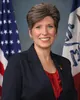
MEMBER OF CONGRESS

Joni Ernst

Follow by RSS

Ernst focuses heavily on government waste, fraud, and transparency, returning repeatedly to figures on fraudulent billing, undocumented spending contracts, and cases of scammers exploiting federal programs; she backs these claims with specific dollar amounts and named agencies, and her concrete asks are usually disclosure requirements and eligibility checks through her own bipartisan bills. She credits the Trump administration and Congress with progress on manufacturing and often frames Democratic opposition as the obstacle to passing her legislation, though much of her bipartisan work is credited to both parties by name. A distinctive habit of her speaking is hiding who did what behind passives and euphemisms—saying things like “have even been handed out” or “the inability to safeguard small business assistance” without naming the agency or officials responsible—far more often than most members; on the other hand, she rarely mocks or belittles opponents, preferring colorful fraud anecdotes to personal attacks. She also devotes regular floor time to her home state, honoring an Iowa small business each week and tying supply-chain legislation to rural Iowans.Written by AI from their statements. Updated .

Average grade
B+
81 / 100 over 10 statements
Signal 68 / 100
Relevance 100 / 100
Reasoning 88 / 100
Respect 100 / 100
Clarity 94 / 100
Averaged over the 10 of 10 statements graded so far.

In their own words

Statements 10

Senate ·

National Park System Long-Term Lease Investment Act

“I am disappointed that Senate Democrats blocked this bipartisan group of bills. These bills stop fraud against the government. They make sure people actually qualify for aid programs before getting money, so help goes to poor families, veterans, and the elderly instead of scammers.”
Official Congressional Record

Mr. President, I am sorely disappointed today that we were not able to pass this commonsense legislation. And we have seen, time and time again, actual examples being put forth in this body to demonstrate the grift of these scammers. And, unfortunately, we are not able to pass what is bipartisan legislation--a package of bills that has passed through many of the various committees here in the U.S. Senate--again, a bipartisan package that stops the grift and the scamming of the Federal Government. We held a committee hearing, not too long ago, where I had in front of me, in the Small Business Committee, a woman that came from Minnesota. She started off her testimony by saying: I am a Democrat, but I can’t stand by idly and watch as money is flowing out the door to the grifters. She gave very powerful testimony. She worked for the State government, and she saw the rampant fraud that was happening in Minnesota. She raised it to her supervisor. She raised the issue to those in charge, and she was told to be quiet and not question what was going on. It eventually led to her firing. But the problem was--and she brought it forward. She said: Every dollar that was being scammed that I identified, it was important to me that it get to the families that need it. Why? Because at one time, I had been part of one of those families. She grew up in a family that was poverty-stricken and filled with abuse. Their family relied on those dollars for their support and yet, as a grown adult, she saw scammers taking advantage of those programs that are meant for the elderly, for the veterans, for those that are struggling to break free from poverty. And what happened to her? She was fired. So this is commonsense legislation, checks and balances put on those programs. For everyone enrolling in those programs, we should check to make sure that they do qualify and meet Federal law and regulations. So, again, I am very disappointed that the Democrats have rejected this, again, a bipartisan package of bills meant to save our taxpayer dollars for people that are truly vulnerable. I am sorely disappointed. I yield the floor.

“I want the Senate to pass my bill right now to stop government fraud. Scammers steal more than $500 billion from federal programs every year. This bill will investigate suspicious payments, ban convicted fraudsters from getting federal money, and take back stolen funds. It could save taxpayers $240 billion.”
  • Speech in the House

    Reasoning 100 of 100

    This statement drew 6 conclusions and gave a reason for each one.

    See full analysis
Official Congressional Record

Mr. President, while hard-working Americans are struggling to afford basic necessities, there is one class of people who have never had it better: fraudsters. Scammers are stealing more than $1.4 billion from taxpayers every day. Yesterday, I released a list of con artists who each fraudulently billed government programs for $1 billion or more. These billionaire bandits looted programs for the elderly, poor, disabled, and veterans to lavish themselves with million-dollar mansions, Rolex watches, expensive jewelry, and luxury cars. One fraudster brags: He ripped off Medicare for over a decade before getting turned in and said: Based upon the numbers, he isn’t lying. If grift were a government Agency, the ``Department of Fraud’’ would be the fifth largest. The $521 billion going to fraud every year exceeds the individual annual budgets of the Departments of Veterans Affairs, Agriculture, Transportation, Homeland Security, State, and Justice. That is right, folks--fraudsters are being better taken care of than our veterans and farmers. Fraud is not a victimless crime, either. In fact, it has far-reaching consequences. We have learned that taxpayer dollars stolen from the U.S. Small Business Administration financed the assassination--yes, you heard it right--the assassination of Haiti’s President in 2021. A team of Colombian mercenaries and their pistols, rifles, and tactical gear were all paid for with the support of $840,000 fraudulently obtained from the Small Business Administration. The political instability resulting from the assassination forced hundreds of thousands of Haitians to flee their nation, taking refuge in the United States. The Biden administration provided many of these migrants with food stamps and medical care--also paid for by American taxpayers. The inability to safeguard small business assistance resulted in taxpayers footing the bills for both the crime and its consequences. Many of these scams also involve identity theft that upends the lives of the unsuspecting Americans who then must suffer the consequences. For example, the Medicare number of a woman in California was stolen by scammers who used it to fraudulently bill for hospice care. When she sought physical therapy for an injury, Medicare denied her coverage because she was listed as dying in hospice. Think about that. The same government Agency that wouldn’t provide her with the healthcare she was promised approved and paid for bogus medical bills submitted by scammers using her information. Medicare exists to ensure folks like her receive medically necessary care, not to make billionaires out of fraudsters. Yet the identities and personal information of more than 1 million Americans have been stolen by Medicare mobsters to file phony healthcare claims. One illegal alien submitted at least $1.3 billion in fraudulent claims to Medicare and other health insurers, over just 6 months, using stolen identities. He laundered millions of the stolen tax dollars overseas to the Russian mob before some of his victims alerted Medicare that they were receiving notices for care and items they did not receive prescribed by doctors they had not visited. Another con artist orchestrated a billion-dollar fraud machine that used foreign call centers to submit bogus bills. He treated programs meant to care for the elderly, veterans, and servicemembers like his own personal cash register. From fake daycare centers to phony small businesses, the examples are absolutely endless, but the public’s patience is not. According to the latest Gallup poll, 9 out of 10 Americans say government corruption is widespread. That is a record high number. I challenge you to find any other issue where Democrats, Republicans, and Independents agree with each other more strongly. We owe it to all Americans to stop the government grift. My Protecting American Taxpayers Act would do just that by stopping government Agencies from handing out quick cash with no questions asked, triggering automatic investigations when there are sudden and suspicious spikes in payment claims, banning convicted fraudsters from receiving taxpayer dollars, taking back the money that was already stolen, and sending those darn scammers to the slammer. If enacted, this bill could save $240 billion. That is billion with a ``b,’’ folks. The choice is quite simple. Give the money to the fraudsters or return it to the taxpayers. What would really be criminal is if the Senate left town today without passing this meaningful legislation to eliminate fraud. As if in legislative session, and notwithstanding rule XXII, I ask unanimous consent that the Senate proceed to the immediate consideration of Calendar No. 452, S. 4952. I further ask that the bill be considered read a third time and passed and that the motion to reconsider be considered made and laid upon the table.

Senate ·

Critical Infrastructure Manufacturing Feasibility Act

“I want the Senate to pass this bill. The United States relies too much on other countries for essential goods, from minerals for our military to everyday items like microchips and baby formula. This bill studies what critical products we import so we can start making them here at home instead.”
Official Congressional Record

Mr. President, I want to thank my colleague from Delaware for bringing up our Iowa State Cyclones and our University of Iowa Hawkeyes. We had the Cy-Hawk game just 2 weekends ago. Unfortunately, my Cyclones fell to the Iowa Hawkeyes. But God bless Coach Kirk Ferentz and his Iowa Hawkeyes. It was another great game for all of Iowa. Mr. President, I am here today to talk a little bit more about our national and economic security of the United States. This has really been the focus of my career--protecting that national and economic security. In 1940, the United States became the ``Arsenal of Democracy,’’ and our country came together to quickly accelerate production of weapons, vehicles, food, and supplies that enabled the allies to defeat the axis powers. Americans in factories, farms, small businesses, and across the country did what was necessary to make what was needed. Instead of internalizing the lesson that our ability to make these critical items in the United States led to great success, we spent much of the last 50 years off-shoring our jobs and our manufacturing capabilities. This is something China, Russia, and other nefarious actors around the world have been all too happy to accommodate and to take on themselves. Today, we have only one active facility producing cannon barrels. Today, we rely 100 percent on foreign sources for 12 critical minerals essential to our military and our economy. During COVID, we saw what happened when supply chains are strained. There was a global shortage of microchips, which upended manufacturers’ ability to make everything from cars to computers. At the same time, moms in the Midwest had to worry about finding baby formula due to supply chain issues at both the production and shipping levels. Put simply: We have lost the ability to make what we need right here at home. In the event of a conflict with one of our near-peer adversaries, supply chains will be challenged, and the United States will have to make what it needs. Thank goodness President Trump, his administration, and Congress have been taking steps to put us on the right track and bring back the manufacturing capabilities we need here at home. My bipartisan Critical Infrastructure Manufacturing Feasibility Act builds on these efforts. My bill, which has already passed the Senate unanimously, directs the Secretary of Commerce to identify critical goods that are currently being imported and find ways to help domestic producers manufacture them in the rural areas and shovel-ready industrial sites. Rural Iowans are ready to roll up their sleeves and build the factories and processing facilities we need to secure our supply chains. We can and need to make things here. But you can’t fix vulnerabilities you can’t see, which is why my bill gives Congress and the executive branch the visibility necessary to identify gaps and then close them. I am grateful to Representative Mariannette Miller-Meeks for introducing the House version of this bill, and for the House of Representatives passing the bill unanimously. Now it is time for the Senate to act and send this bill to the President’s desk. Mr. President, notwithstanding rule XXII, I ask unanimous consent that the Committee on Commerce, Science, and Transportation be discharged from further consideration of H.R. 1721 and that the Senate proceed to its immediate consideration.

Senate ·

Stop Secret Spending Act of 2025

“I want the Senate to pass this bill today so it becomes law. It requires the government to list all of its spending agreements on a public website. Right now, agencies hide tens of billions of dollars in special deals. Taxpayers deserve to see where that money goes.”
Official Congressional Record

Mr. President, taxpayers deserve to know how the money they send to Washington is being spent. For 20 years now, the Federal Funding Accountability and Transparency Act has required unclassified government spending to be put online in a searchable public website, USAspending.gov. This allows taxpayers to review the receipts for themselves. Bureaucrats, however, have been hiding tens of billions of dollars distributed through secret spending arrangements known as other transaction agreements, or OTAs, by not publicly disclosing these expenditures on USAspending.gov. With fraudsters stealing $1.4 billion every single day, we need this information now so we can account for who is taking tax dollars and why. In June, the Senate unanimously passed my bipartisan Stop Secret Spending Act to require OTAs to be publicly disclosed on USAspending.gov, just like all other government spending. Last month, the House approved the bipartisan companion bill introduced by Representatives Moore and Panetta. Democrats and Republicans in both the House and Senate agree that Washington needs to finally end the secrecy about how tens of billions of dollars are being spent every year. That is a win for everyone, especially our taxpayers. Let’s send this bill to the President today so it becomes law. Mr. President, notwithstanding rule XXII, I ask unanimous consent that the Senate proceed to the immediate consideration of H.R. 2069, which was received from the House.

Senate ·

Unanimous Consent Request--H.R. 2069 (Executive Calendar)

“I am disappointed that the Senate is blocking this bill just because it comes from the House. It does not matter whose name is on a good bill or which chamber wrote it. We should pass good, bipartisan bills instead of fighting among ourselves.”
  • Speech in the House

    Reasoning 100 of 100

    This statement drew 4 conclusions and gave a reason for each one.

    See full analysis
Official Congressional Record

I can appreciate the dilemma that many of us are in as we debate these very important bills, and they are very important bills. So what I have in front of me here at my desk is a list of 59 House bills that have been passed this Congress. They are H.R. bills. They are H.J. Res. 140; H.R. 7147--59 House bills that have already passed through the Senate in this Congress. Now, I understand that we all have ways that we have to use leverage. I completely understand that. As a matter of fact, the bill that I had passed through this Chamber, you know, I would love to have it as an S. bill, a Senate bill, and I would love to see my name at the top of the bill rather than a House bill. The companion bill was passed by the House. So, again, I would love to see my name at the top of the bill and it listed as a Senate bill. I discussed it with my staff. I am in the last 6 months of my final term in the U.S. Senate. I would love to have more of my legacy items with my name on them, but I told my staff that it is more important that we get these bills done. I don’t care if it is a House bill. I don’t care if this has my name all over it. The important thing is that when we have good pieces of legislation put in front of us and that we worked hard in a bipartisan manner, in a bicameral manner, and it is good for the American people, that we move forward with those bills. So I am disappointed today that my piece of legislation under the title of a House bill will not be moving, and I know that many of our constituencies will be greatly disappointed. I do hope in the future that, between the Senate Republican leadership and the House Republican leadership, we can come together on these issues because it is not good for the American people when we have this infighting on good, solid pieces of legislation. We can do better.

“I want the Senate to pass this bill immediately. It requires the government to list all special, hard-to-track contracts on a public website so taxpayers can see how their money is spent.”
Official Congressional Record

Mr. President, during my 12 years in the Senate, I have exposed many outlandish examples of government waste. For example, I uncovered that Washington sent nearly $500 million to China to pay for everything from poetry projects to dangerous research on bats. Another $870 million of U.S. taxpayer money went to Russia. This includes more than $770,000 from the National Institutes of Health sent to a state-run lab in Russia to put cats on treadmills. How did I uncover these crazy trails of money to our foreign adversary? It is quite simple. For 20 years now, the Federal Funding Accountability and Transparency Act has required unclassified government spending to be put online in a searchable public website, usspending.gov. This allows taxpayers to see for themselves how the money they are sending to Washington is spent. Bureaucrats, however, have been hiding tens of billions of dollars distributed through secret spending arrangements known as other transaction agreements, or OTAs, by not publicly disclosing these expenditures on USAspending.gov. The Pentagon alone has obligated $77.7 billion for thousands of OTAs over just the past 5 years through over 30,000 hard-to-track contracts. The lack of transparency with OTAs is having a real impact. According to the Government Accountability Office, the Pentagon ``cannot assess the extent to which OTAs are delivering capabilities to the warfighter.’’ The Office of the Inspector General also found the Pentagon doesn’t even have an accurate count of OTAs or their dollar values. OTAs are also being used by the Departments of Health and Human Services, Homeland Security, Transportation, Energy, as well as NASA. We recently learned that NIH’s new ARPA-H biomedical research contracts are being processed as OTAs through the Interior Department. This means if you want to know the details behind NIH’s biomedical research contracts, you practically have to be a data wizard and know where to look deep in the Department of--where did I say?--Department of the Interior’s databases. I know, it makes no sense. As we witnessed last week, we can’t get answers from Dr. Fauci about what NIH has been funding because he is hiding behind the Fifth Amendment. Taxpayers deserve to know how their dollars are being spent in Washington, and we have an obligation here to show them. In June, the Senate unanimously passed my bipartisan Stop Secret Spending Act to require OTAs to be publicly disclosed on USAspending.gov just like all other government spending. I very much appreciate Senators Peters and Hassan, whose support was critical for making this happen. I was also delighted last month when the House approved the bipartisan companion bill introduced by Representatives Moore and Panetta, which is now at the desk here in the Senate. We all know Congress can’t agree on very much these days, so it makes a very powerful statement when folks on both sides of the aisle and from both Chambers come together by passing this transparency bill to hold Washington accountable for how Americans’ tax dollars are being spent. With fraudsters stealing $1.4 billion every single day, we need this information now so we can account for who is taking tax dollars and why they are taking them. Earlier today, I attended the meeting of the Vice President’s Task Force to Eliminate Fraud at the White House, and the success of this effort depends on being able to track how dollars are being spent. Unfortunately, some Governors are impeding anti-fraud efforts by blocking access to spending information about how tax dollars from Washington are being spent in their own States. We can’t stop what we can’t see, but we can do our part by passing the Stop Secret Spending Act today. This bill will end the secrecy about how tens of billions of dollars are being spent every single year. There are no excuses for delaying sending this bill to the President today to become law. In fact, the only reason to oppose the Stop Secret Spending Act is if you have something to hide. As if in legislative session and notwithstanding rule XXII, I ask unanimous consent that the Senate proceed to the immediate consideration of H.R. 2069, which was received from the House. I further ask that the bill be considered read a third time and passed and that the motion to reconsider be considered made and laid upon the table.

Senate ·

Authority for Committees to Meet

“I am asking permission for 11 Senate committees to meet today. Leaders from both parties have approved these meetings.”
Official Congressional Record

Mr. President, I have 11 requests for committees to meet during today’s session of the Senate. They have the approval of the Majority and Minority Leaders. Pursuant to rule XXVI, paragraph 5(a), of the Standing Rules of the Senate, the following committees are authorized to meet during today’s session of the Senate: The Committee on Armed Services is authorized to meet in executive session during the session of the Senate on Wednesday, July 22, 2026, at 2 p.m. The Committee on Commerce, Science, and Transportation is authorized to meet in executive session during the session of the Senate on Wednesday, July 22, 2026, at 10:30 a.m. The Committee on Energy and Natural Resources is authorized to meet during the session of the Senate on Wednesday, July 22, 2026, at 9:30 a.m., to conduct a hearing. The Committee on Environment and Public Works is authorized to meet during the session of the Senate on Wednesday, July 22, 2026, at 2 p.m., to conduct a business meeting. The Committee on Finance is authorized to meet during the session of the Senate on Wednesday, July 22, 2026, at 10 a.m., to conduct a hearing. The Committee on Foreign Relations is authorized to meet during the session of the Senate on Wednesday, July 22, 2026, at 9 a.m., to conduct a business meeting. The Committee on Health, Education, Labor, and Pensions is authorized to meet in executive session during the session of the Senate on Wednesday, July 22, 2026, at 10 a.m. The Committee on Homeland Security and Governmental Affairs is authorized to meet during the session of the Senate on Wednesday, July 22, 2026, at 9:30 a.m., to conduct a business meeting. The Committee on Indian Affairs is authorized to meet during the session of the Senate on Wednesday, July 22, 2026, at 2 p.m., to conduct a business meeting. The Committee on Veterans’ Affairs is authorized to meet during the session of the Senate on Wednesday, July 22, 2026, at 4 p.m., to conduct a hearing. The Select Committee on Intelligence is authorized to meet during the session of the Senate on Wednesday, July 22, 2026, at 3 p.m., to conduct a closed briefing.

Senate ·

Protecting American Taxpayers Act (Executive Calendar)

“Scammers steal about 1.4 billion dollars in taxpayer money every day because the government sends out funds without checking who gets them. I want the Senate to pass my bill to stop this. It will require agencies to verify claims before paying, investigate suspicious spikes in applications, recover stolen money, and punish fraudsters.”
Official Congressional Record

Mr. President, we have all received that email from a wealthy Nigerian ``Prince,’’ asking us to wire him some money with promises that he will return the favor with a huge reward as soon as he can access his fortune, or we have gotten that phone call from an unknown number claiming to be the IRS, warning that an arrest warrant will be issued if we don’t immediately pay off our outstanding tax debt, and, of course, everyone has been told that our extended vehicle warranty is about to expire unless we renew immediately. Folks, we all know these are scams, and we aren’t being fooled. Yet, somehow, government bureaucrats are being bamboozled by even less sophisticated schemes, except they are not giving out access to their own bank accounts but, rather, to taxpayer dollars and the U.S. Treasury. Folks, I am not making this up. A Nigerian socialite actually submitted more than 100 fraudulent applications for unemployment and disability assistance that were approved. He finagled more than $1.3 million of U.S. taxpayer money in this scheme. Some of the funds were intended to provide daycare services for disabled children, but he, instead, spent the money on constructing a luxury resort and nightclub in Nigeria. This Nigerian ``Prince of Fraud’’ was outdone by California prison inmates, who collected about $1 billion in unemployment benefits by using names like ``John Doe,’’ ``John Adams,’’ and ``Poopy Britches’’ while serving time behind bars. Other con artists successfully applied for COVID cash during the pandemic by using the names of well-known celebrities and fictional characters, like ``Charlie Brown’’ and ``Nancy Drew.’’ Taxpayer dollars have even been handed out to phony businesses with such obviously made-up names that are so outrageous that no one could possibly believe they were real, such as ``Satanic Lives Matter’’ and others that are so tasteless I can’t even say them. Others uploaded pictures of doll faces to ``verify’’ their identities on applications for government assistance and were still approved. Too often, the bilking is being done by the very bureaucrats who are overseeing the benefits. Over the years, I have documented countless examples of government employees who have been caught with their hands in the cookie jar--embezzling millions of dollars and abusing their positions for personal gain. As a veteran, one particular example that really makes my blood boil involves a service representative for the Department of Veterans Affairs who was shaking down disabled veterans for bribes to ``grease the wheels’’ to speed up the approval of backlogged claims. A $3,385 kickback paid to him via Venmo was listed on the memo line as ``crooked shit.’’ I apologize for my language, but that is what the Venmo actually said. We had to modify our chart today. So a VA representative was shaking down disabled veterans. This actually happened. That representative was caught and is being held responsible for shaking down our disabled veterans. The problem in most of these cases is the money is going out the door before verifying if the recipient is legitimate. If fraud is later detected, then the government has to decide if it is worth trying to recover the stolen money. This pay-and-chase system makes it way too easy for scammers to take the money and run. It is like giving the cash advance and your bank routing number to the Nigerian ``Prince’’ who promised you a financial reward for your help only for you to realize, later, you have been ripped off. Good luck getting any of your money back. It is the grift that keeps giving. As a result, fraudsters are getting away with stealing more than $1.4 billion in taxpayer money every single day. Every single day, folks, $1.4 billion fraudsters are making off with. If grift were a government agency, the ``Department of Fraud’’ would be the fifth largest. The $521 billion going to fraud every year exceeds the individual annual budgets of the Departments of Veterans Affairs, Agriculture, Transportation, Homeland Security, State, and Justice. That is right, folks. Fraudsters are being better taken care of than our veterans and our farmers. While hard-working Americans are struggling to make ends meet, fraudsters are living large on the loot that they are taking from the Treasury. Government grift and graft are endless, and so are the excuses for not stopping it, but the public’s patience isn’t. So who is responsible for allowing fraud to continue? Folks, the buck stops right here with Congress. Congress decides how much of your paycheck must be sent to Washington, and it writes the laws determining exactly how every one of those dollars is spent. But the haste to spend trillions of tax dollars as quickly as possible is resulting in outrageous amounts of waste, fraud, and abuse. From fake childcare centers in Minnesota to convicts collecting unemployment checks, fraudsters are blatantly getting away with treating the National Treasury like their own personal piggy bank. At the request of Majority Leader Thune, I have compiled a comprehensive package of proposals put forth by our Senate colleagues on both sides of the aisle to end fraud once and for all. Specifically, my Protecting American Taxpayers Act will stop handing out quick cash with no questions asked, trigger automatic investigations when there are sudden and suspicious spikes in payment claims, ban convicted fraudsters from receiving taxpayer dollars, take back the money that was already stolen, and send scammers to the slammer. If enacted, this bill would save $240 billion. The choice is quite simple: Give this money to fraudsters or return it to the taxpayers. The bill is now before the Senate, and every day we delay in passing it, grifters are getting away with stealing another $1.4 billion. Allowing that to continue is the greatest fraud of all. I yield the floor.

Senate ·

Recognizing Shinytop Brewing

“I am naming ShinyTop Brewing in Iowa as the Senate Small Business of the Week. Two brothers started the brewery, and they have helped grow their town and give back to the community.”
  • Speech in the House

    Signal 43 of 100

    Much of this statement went to praise, blame, greetings, routine procedure or general stories rather than reasons, requests or specific points.

    See full analysis
Official Congressional Record

Mr. President, as chair of the Senate Committee on Small Business and Entrepreneurship, each week I recognize an outstanding Iowa small business that exemplifies the American entrepreneurial spirit. This week, it is my privilege to honor ShinyTop Brewing of Webster County, IA, as the Senate Small Business of the Week. With a vision of building a local craft brewing scene in north central Iowa, brothers Nate and Todd McCubbin founded ShinyTop Brewing in 2016 after Nate, a military veteran, discovered a passion for homebrewing. The brothers’ venture was born from a desire to create something their hometown could take pride in. What started with sharing their craft beer among friends and family soon revealed a deeper purpose: building community through brewing. A simple hobby quickly grew into a meaningful opportunity to bring people together, foster connections, and create a gathering place centered around great craft beer. Over the years, ShinyTop experienced significant growth, expanding both its physical space and its menu offerings. More than a decade later, the brewery has become a fixture in Fort Dodge. The brewery has remained a beacon of opportunity for the city. Fostering a welcoming environment, the McCubbins have sought to build relationships and connect their visitors to the city’s vast art, music, and philanthropic spheres. Yet for Nate and Todd, the true measure of success is not the brewery’s growth, but the positive impact it has had on the area and the relationships it has helped foster along the way. The brothers successfully turned a dilapidated building into what ShinyTop is today. Although the business physically resembles a brewery, the brothers say that it is representative of much more than that, ShinyTop is an instrument to cultivating community growth, while sharing family values. As a member of the Greater Fort Dodge Growth Alliance and the chamber of commerce, ShinyTop prioritizes economic and social development in the city. In addition to ShinyTop’s engagement, the McCubbin brothers are also heavily involved in the community; Nate is on the board of the Fort Dodge Fine Arts Association, and Todd is a member of the city council. Through individual and group efforts, these entrepreneurs are looking to positively impact their community. By partnering with local organizations, the brewery has fostered meaningful engagement while supporting local initiatives, strengthening neighborhood connections, and contributing to the overall growth and well-being of Fort Dodge. In the spirit of supporting the area, ShinyTop has partnered with the Fort Dodge Fine Arts Association, Serving our Servants, Fort Dodge Firefighter’s Association, and has collaborated with other local organizations. More recently, the brewery has introduced its Giving Tuesday initiative in which 10 percent of its sales are donated to a partnering charity or organization. ShinyTop and the McCubbins continue to prove their generosity and enthusiasm to give back to the area. I am pleased to recognize Nate and Todd McCubbin along with the entire team at ShinyTop Brewing for their dedication to the Fort Dodge community. I look forward to their continued success and wish them the very best in the years ahead.

Senate ·

Remembering Lindsey Graham (Executive Session)

“I am honoring Senator Lindsey Graham. He was a funny man, a good friend, and a strong leader who served our military and our country for many years.”
  • Speech in the House

    Signal 9 of 100

    Much of this statement went to praise, blame, greetings, routine procedure or general stories rather than reasons, requests or specific points.

    See full analysis
Official Congressional Record

Mr. President, I rise today with a heavy heart to honor my dear friend and colleague Senator Lindsey Graham of South Carolina. Before he ever set foot on this floor, he wore the uniform of the U.S. Air Force, serving 33 years between the Air Force, the South Carolina Air National Guard, and the Air Force Reserve. That service and his upbringing in the back of his parents’ South Carolina bar shaped everything about how he approached his work here in the Senate. He understood, in a way too few in Washington, DC, do, what it costs to defend freedom. He was one of the loudest, most persistent voices this institution has seen on the importance of American leadership in this world. And before I joined the Senate, Lindsey was one of my earliest supporters. I am so grateful for his mentorship and his friendship throughout the years. Lindsey was really dear to my family. My mother’s birthday was just a few days before Lindsey’s, and through the years, he would call her on her birthday and wish her the happiest of birthdays. As my daughter entered the U.S. Army, he would call her and just give her words of encouragement--in the hilarious way that only Lindsey Graham could. He was such a good and decent man. One thing we all knew about Lindsey was his great sense of humor. I will never forget the gift he gave me after I won Iowa’s Senate seat. In fact, I may be the only Senator in history to be handed a mounted castration clamp with a plaque engraved ``Make `Em Squeal, Joni!’’ just off the floor of this Chamber, courtesy of Lindsey Graham. And I think he is probably still laughing about that one. Earlier this year, we were talking about Lindsey, doing dinner with Lindsey, as many of us did, and we were talking about this year’s race because he was running for another term in the Senate. And my mother, again, being very close to Lindsey and his No. 1 fan in Iowa--in fact, she had a screen saver on her computer. It was her and Lindsey Graham. If you asked my mother who her favorite Senator was, it wouldn’t be Senator Chuck Grassley or even her own daughter; it would be Senator Lindsey Graham. She was agonizing: Should I send Lindsey a donation for his campaign? And I was laughing about this with Lindsey. So he was like: Give me your phone. He said: Let’s shoot a video for your mom. And so he took my phone, and he made this cute little 10-second video. And it went something like this: Marilyn, we love you. We love Joni. I know times are hard, but send money anyway. Lindseygraham.com. He did that all the time, and he was always so funny. And I can’t tell you how many times I have watched that video, over and over again, and just laughed. He was certainly a very funny man, even when times were difficult, but behind the jokes was one of the most serious and effective legislators this body has ever known. He didn’t care whose name was on a bill if the policy was right. He brokered friendships and alliances that many in this town said were no longer possible. He fought hard, and then he would sit down and crack a joke with the people that he had just been arguing with. All of us here on this floor know that Lindsey was always moving. The man never stood still. He was always working the phones--phone call after phone call--whether it was President Trump or my mom back in Iowa. He was always certain that presence was power. I had the privilege of traveling many times over with Lindsey. The very first codel, which is a congressional delegation trip, that I took in the U.S. Senate was with Lindsey. It was to the Munich Security Conference in Germany. The other Senators on that trip were former Senator Joe Lieberman, a dear friend of his; Senator John McCain, who was his deepest and truest friend; and Senator Kelly Ayotte. We had a wonderful trip together. And it was such a great experience for me to see him on the world stage, easily moving from conversation to conversation with some of the world’s most important and powerful leaders, and to see how much they deeply respected Senator Graham. His contributions to conflict resolution went well beyond the United States. Just days ago, Lindsey was in Ukraine meeting with President Zelenskyy and standing with a nation fighting for its survival because he believed at his core that American leadership was the difference between peace and oppression. Lindsey Graham was tough, he was funny, and he loved this country. To the people of South Carolina and to Lindsey’s family and, most especially, to his sister Darline and all who loved him, we are all mourning together. As a Christian like Lindsey, I know God will bring comfort where there is fear, strength where there is shock, and hope where there is loss. Lindsey, we miss you, and this Chamber will never be the same without you. Godspeed, my dear friend, and thank you for your service. I yield the floor.